The Craft of Wooden Boatbuilding: Why Timber Still Sails
Walk into a working wooden boatshop and the first thing that reaches you is the smell — oak shavings, cedar dust, pine tar. It is the smell of one of humanity's oldest continuous crafts, and despite fiberglass conquering the marinas, it has never gone away.
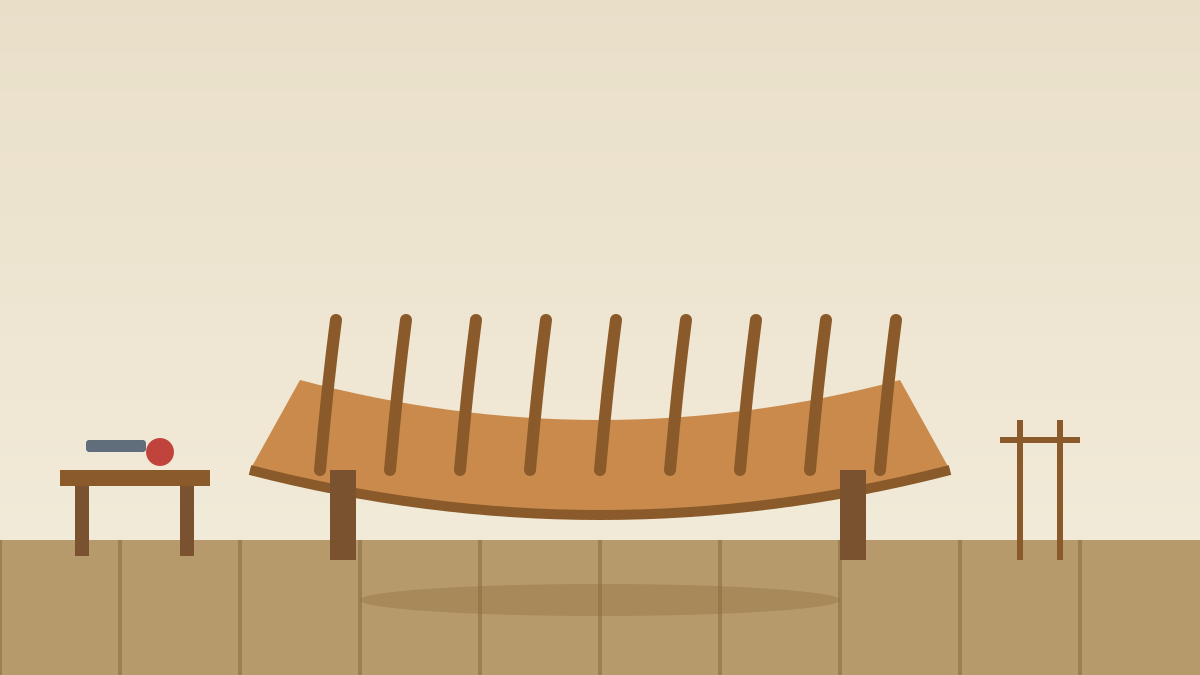
Two ways to plank a hull
Most traditional wooden hulls follow one of two systems. In carvel construction, planks lie edge to edge over a skeleton of frames, producing a smooth hull whose seams are sealed with caulking. In clinker (or lapstrake) construction, planks overlap like roof shingles, creating a light, springy hull with distinctive shadow lines — the method of Viking ships and countless northern workboats. Each system shapes not just the look of a boat but how it flexes, sounds, and ages.
The skeleton: keels, frames and steam
A traditional hull begins with its backbone — keel, stem and sternpost — usually of oak. Onto it go the frames, the ribs of the boat. Many are steam-bent: thin oak strips cooked in a steam box until pliable, then bent hot into the hull and clenched fast before they cool. Watching a crew race a steaming frame from box to boat is still one of the great spectacles of the craft.
Why wood, when fiberglass is cheaper?
Fiberglass won mass production for good reasons. Yet wood keeps its faithful for reasons that are practical as well as romantic. Wood is strong for its weight, stiff yet forgiving, naturally insulating and quiet at sea. A wooden hull can be repaired almost indefinitely — a damaged plank is cut out and a new one fitted, where a composite hull needs specialist patching. And a well-built wooden boat, honestly maintained, appreciates in character the way few industrial products do.
The craft survives by teaching
The knowledge nearly slipped away in the late twentieth century, and the response was schools: dedicated boatbuilding academies now train new generations in lofting, joinery, spar-making and traditional rigging. Restoration yards, classic-boat festivals and wooden regattas complete an ecosystem in which the skills pay wages again. The craft did not survive on nostalgia — it survived on curriculum.
Old methods, new life
Modern wooden boatbuilding is not frozen in the past. Cold-molded construction laminates thin veneers with epoxy into hulls that are light, strong and low-maintenance; modern glues and sealants have solved old problems of leaks and rot; and designers marry traditional lines with contemporary engineering. Timber has quietly become a renewable, carbon-storing alternative in an industry rethinking its materials.
Conclusion
A wooden boat is a conversation between a living material and the sea, mediated by hands that learned from other hands. That conversation has lasted a thousand years — and in shops that still smell of oak and tar, it is nowhere near finished.
Frequently Asked Questions
Are wooden boats still built today?
Yes. Traditional yards and schools around the world still launch new wooden boats every year, from small dinghies to large sailing yachts, and restoration of classic hulls is a thriving specialty.
What woods are used in boatbuilding?
Oak for frames and backbone, cedar and mahogany for planking, teak for decks and trim, and spruce for spars are classic choices, each picked for strength, rot resistance or flexibility.
How long does a wooden boat last?
With regular maintenance, many decades — some working wooden boats are over a century old. The material can be repaired plank by plank, which is part of its longevity.
Is a wooden boat harder to maintain?
It demands more routine care than fiberglass — painting, caulking, ventilation — but repairs are more local and forgiving: damaged wood is cut out and replaced rather than patched over.
Sources & Further Reading
- International Maritime Organization (IMO): imo.org
- US Coast Guard Boating Safety: uscgboating.org
- National Maritime Museum collections and references